
For The Record
August 1, 2026
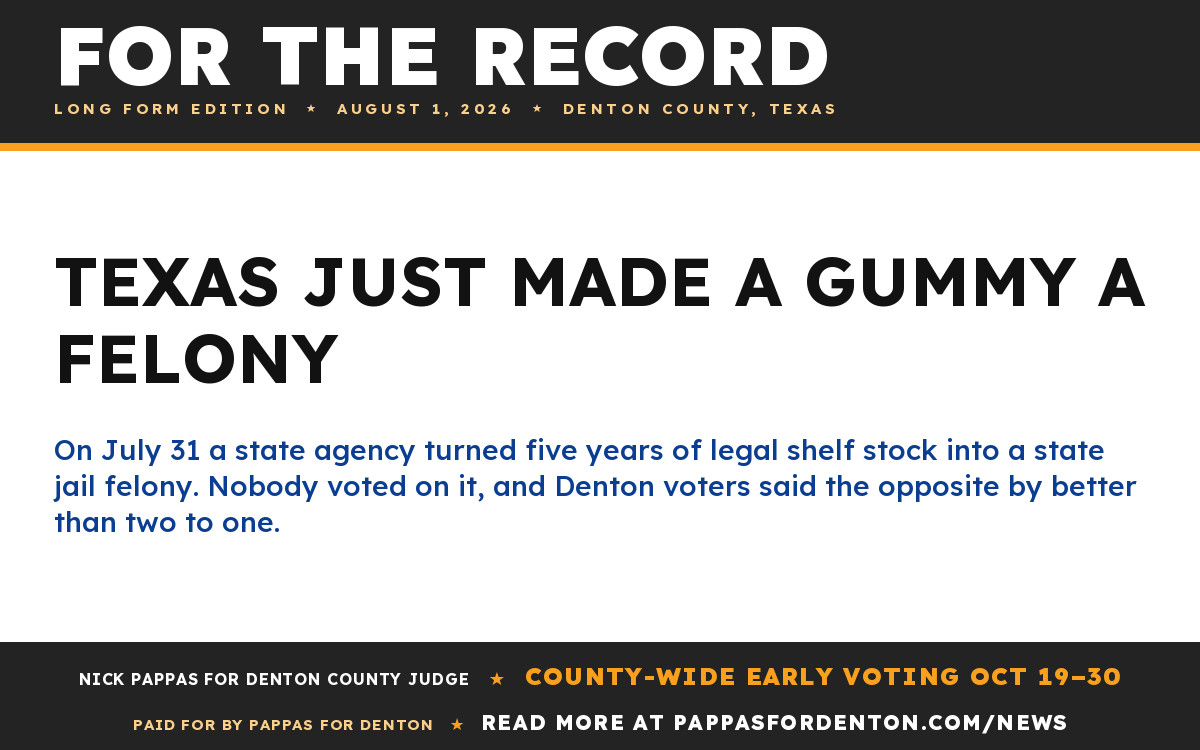
TEXAS JUST MADE A GUMMY A FELONY
On July 31 a state agency turned five years of legal shelf stock into a state jail felony. Nobody voted on it, and Denton voters said the opposite by better than two to one.
Share to social media
Post the image. It travels further than a link.
On Thursday you could walk into a gas station in Lewisville, TX and buy a delta-8 gummy off the counter. On Friday, having that same gummy in your pocket is a state jail felony. Up to two years locked up. Up to $10,000.
Nothing about the gummy changed. Nothing about the person changed. A state agency reinstated a rule it wrote in 2021, the Texas Supreme Court lifted the injunction that had been blocking it since, and on July 31 the whole thing switched on.
The Legislature did not pass a law. Nobody voted on this. The Department of State Health Services reclassified every form of THC except delta-9 as a Schedule I controlled substance, the same schedule as heroin. Delta-8, delta-10, THCP, THCA flower. Schedule I.
They banned the weak one and kept the strong one
Delta-9 THC is fine. Under 0.3% by dry weight, you can still buy the edibles, the drinks, the tinctures. Delta-9 is the compound that actually gets you high in marijuana. It is the strong one.
So Texas banned the weaker cousins and kept the potent original on the shelf. Read that twice, because it is the whole policy.
And two ounces of plain marijuana flower is still a Class B misdemeanor in this state. A ticket-level offense by comparison. But the gummy that hits softer will get you a felony conviction and a record you carry for the rest of your life.
Your first drunk driving arrest in Texas is a Class B misdemeanor. Up to 180 days, up to $2,000. Your first gummy is a state jail felony. Up to two years, up to $10,000.
This drug policy is more full of shit than a lettuce patch at Taylor Farms.
Nobody can tell what is legal by looking at it
Not you. Not the cop who pulls you over. Not the store that sold it to you.
The difference between a legal product and a felony is which molecule is in it and at what concentration. You cannot see that. You cannot smell it. The label is not the law, and a package that says delta-8 does not become legal because the store had it in stock last week.
Only a lab can settle it. A lab result takes weeks or months. The arrest takes about 20 minutes.
Attorneys are already warning that officers are going to detain people carrying perfectly legal hemp because there is no way to tell the products apart in the field. Those people will get sorted out eventually. After the booking. After the bond. After the phone call to a boss explaining why they are not coming in.
The state licensed the stores that sold it
There are roughly 14,000 retailers in Texas licensed by the state to sell consumable hemp. The state issued those licenses. The state collected those fees. For five years, while a court order blocked enforcement, those stores sold delta-8 openly and legally.
Texas built the market, permitted the market, taxed the market, and then made the customers criminals.
Industry people expect somewhere between 60% and 90% of THC products to come off shelves. Small businesses across Denton County are going to eat that. Not the state agency that flipped the switch.
Their one argument, and why it fails on its own terms
They did not sell this as a drug war. They sold it as protecting kids. So let me take that seriously and then show you what it is worth.
Calls to Texas poison centers involving cannabis went from 923 a year to roughly 2,600. Children under five and teenagers are the two biggest groups. That is real and I am not going to wave it off.
Here is what those calls actually are. The largest study, published in the journal Pediatrics, looked at 7,043 exposures in children under six. 4% needed oxygen. 0.7% were intubated, which is 35 children over five years, about one in 140. A separate review of roughly 22,000 pediatric cases found 7% went to the ICU and 0.2% needed a ventilator. Nobody died. Not in any of it.
The other 95% got IV fluids, a snack, and eight to 12 hours of somebody watching them until they came back to normal. There is no antidote because none is needed. A drowsy, scared, vomiting toddler in an emergency room is a terrible night for a family. It is not what the word poisoning is doing when a senator says it into a microphone.
And the rising call count is not the smoking gun they think it is. Calls go up when a product is legal and sitting on shelves. Calls also go up when people stop being afraid that asking for help gets them arrested. Children under six are already close to half of all poison center calls in Texas for everything, cleaning supplies included. Nobody filed a bill making Fabuloso a felony.
Now here is the part that ends the argument. Almost every one of those pediatric cases is an edible. Gummies, candy, chocolate. And this rule does not touch them. Delta-9 gummies are still legal in Texas, still on the shelf, still in the same bright packaging a four-year-old mistakes for fruit snacks.
They banned the weaker molecule and left the exact product doing the harm right where it was.
So this does not fail because I disagree with their priorities. It fails on their own terms, against their own stated reason, measured by their own evidence. If a plan cannot do the one thing you said it was for, it was not the reason.
What actually protects a kid is child-resistant packaging you have to fight with. A hard cap on milligrams per package. A ban on anything shaped or colored like candy. Real age checks with real penalties for the store that skips them. Every one of those is boring, cheap, and it works, and not one of them requires putting an adult in a state jail.
The answer to a kid eating a gummy is not a felony conviction for a 34 year old with a bad back who bought one at a licensed store.
Denton already voted on this
In November 2022, more than 32,000 people in the city of Denton, TX voted for Proposition B. More than 70% of them. Biggest turnout for a municipal election in the city's history.
Prop B ended citations and arrests for possession under four ounces unless it was tied to a felony narcotics case or a violent felony. It stopped the city from spending money on THC lab testing. And it barred police from using the smell of cannabis by itself as probable cause to search you.
It was never enforced. Not once. The city manager refused to implement it, saying it conflicted with state law. Denton police kept writing tickets and making arrests for low-level possession anyway, 223 of them in the year and a half after the vote. The Attorney General sued Denton and four other Texas cities in January 2024. And in May 2025, after more than $200,000 in legal fees, the Denton City Council voted four to three to repeal the ordinance its own voters had passed.
Austin, TX passed the same thing with around 85%. San Marcos, TX 82%. Elgin, TX 75%. Killeen, TX 70%. Every one of them overridden.
That is the city, not the county, and I am running for county. Different body, different authority, and I am not going to blur it to make a point. But it is the same people. They live here, they pay here, they vote here, and they answered the question by better than two to one.
An unelected city manager told them no. The Attorney General told them no. A state agency nobody gets to vote for told them no. Now a court has told them no.
You do not have to think marijuana should be legal to notice what that looks like.
Denton County pays for this
Here is the part that belongs on a County Judge's desk, and the reason I am writing about a state decision at all. When the state creates a new felony, the state does not pay for it. The county does.
Every one of these cases means a jail bed, a magistrate, a court-appointed lawyer for anyone who cannot afford one, a prosecutor's hours, a forensic lab test, a probation officer, and a courtroom. Denton County taxpayers fund all of it, out of a budget the Commissioners Court writes and votes on every fall.
We are a county that already has a jail staffing problem and a growing population. Adding a new pipeline of felony filings for a product that was sold legally at the Circle K in June is not a public safety win. It is a bill.
And it does not end at the courthouse. A state jail felony follows somebody into every job application, every apartment application, and every professional license they might have been working toward. People who were working and paying taxes stop being able to. Then the county picks up that cost too, at the food bank, at the clinic, at the indigent care line item.
What I would actually do about it
I am not going to bullshit you about the authority of the office. A County Judge does not repeal a state drug schedule. The Sheriff and the District Attorney are separately elected and they answer to the voters, not to me.
What the County Judge and the Commissioners Court control is the money and the priorities. That is not nothing. That is most of it.
I would fund diversion and pretrial services instead of jail beds, because a county gets to decide what it spends its jail budget chasing. I would push our county to put its weight behind changing this at the state level, the same way Denton County lobbies Austin on roads and water when it wants something. And I would put the numbers in public: what these cases cost us per year, in dollars, on the county website, where any taxpayer can find them.
Two lawsuits are already pending in Travis County and there were oral arguments this week. This could change again. It has changed four times in two years, which is its own indictment of how Texas is doing this.
The county budget gets set in the fall. Every one of those hearings is open to the public and almost nobody goes. Go. Ask them what this is going to cost.
How did we get here?
In 2018 the federal Farm Bill removed hemp under 0.3% delta-9 from Schedule I. Texas matched it in 2019 with House Bill 1325. Stores started selling delta-8 on that basis, and the state licensed them to do it.
In October 2021 the Department of State Health Services posted a notice on its website calling delta-8 a Schedule I controlled substance. No bill. No vote. In November a Travis County judge blocked it, finding the agency had not followed the state's own rulemaking requirements. That order held for almost five years.
In June 2025 the Legislature passed Senate Bill 3 to ban THC in consumable hemp. Governor Abbott vetoed it, warning it would make felons out of veterans, parents and patients acting in good faith. Two special sessions followed and produced nothing.
On May 1, 2026 the Texas Supreme Court ruled for the state in case 23-0887. It did not hold that the ban is good policy. It held that state law makes the health commissioner's decision final unless the Legislature changes it, so no court is allowed to review it. The Court called the hemp industry's reading of the law plausible and forceful, and ruled against it anyway. Only the Legislature can undo this now.
The health department published the reinstated definitions on July 10. They took effect July 31.
One piece of plumbing worth knowing, because it explains who to be mad at. The health department does not arrest anybody. All it does is decide what goes on the state's list of controlled substances. Once delta-8 went back on that list, the criminal code did the rest on its own. That is where the felony comes from, and that is why nobody ever had to vote.
The Court's order list: https://www.txcourts.gov/supreme/orders-opinions/2026/may/may-1-2026/
The veto and the special session: https://www.houstonpublicmedia.org/articles/news/texas/2025/06/23/524619/gov-abbott-vetoes-texas-thc-ban-calls-special-session-to-regulate-hemp/
What is still legal: https://www.texastribune.org/2026/07/30/texas-thc-cannabis-ban-delta-9-8-marijuana/
No editions match that search.